

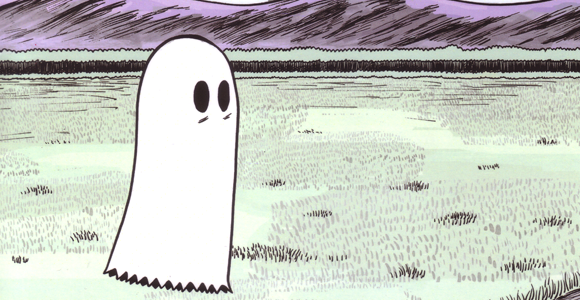


From bucolic explorations of the seasons to child-eating monsters, the works of Joseph Lambert are some of the most original, thought-provoking and sumptuously-drawn comics to emerge in recent years. A graduate of the Center for Cartooning Studies in Vermont, his short stories have been published in various anthologies and in his debut collection from Secret Acres, I Will Bite You!
I spoke to Joe over a glitching, distorted Skype connection about his life, work and love of the colour yellow.
-- Gavin Lees
Where was it that you grew up?
I grew up in Kansas. There’s a little town called Newton. Are you familiar with Kansas at all?
Not at all.
Well, there’s a big city called Wichita and it’s near there.
So it was a fairly typical small town?
Yeah.
What was it like growing up there? Were you exposed to a lot of art and comics while you were growing up?

Maybe… a little bit. I think the only comics I was exposed to were the newspaper comics and there were a few superhero comics that I would read, because it was the ’90s and they were fairly popular for a while. The X-Men cartoon had come out and they were really popular at that time, but I never had a comic book shop in my home town. So I’d get comics at the supermarket, whatever they had. So I was exposed to a little bit.
As far as being exposed to art, my grandfather was a set designer for theatres and a sign painter, and he was a freelance artist for a living and he would expose me to what he was doing and what he thought I might be interested in. So, that’s where a lot of my art knowledge came from as a kid.
Is that where your lettering technique comes from — because you had a pretty unique sense of design in your lettering — did you pick up a lot of techniques from your grandfather?
Maybe. I think so. If nothing else, then I inherited an awareness of the craft of lettering. I guess it was just always in the back of my mind, so maybe that’s where it comes from. I’d never thought about that. I’ve always been aware of it being part of the design process and that it can be fun to play with.
You say that you had a fairly limited exposure to comics as a child — just the funny pages in the newspaper and the odd superhero comics — so when was it that you decided you were going to take it more seriously?
It was pretty early. I don’t ever remember deciding that I wanted to be a cartoonist; it was just always something that I thought I could do. I’ve always been drawing. I never had one of those periods when I stopped. A lot of my peers had a period, you know: they draw when they’re a kid and then they grow out of it for a while, but I never had anything like that. I just drew for a long time. I think having my grandfather be a professional artist was beneficial because then I saw that adults could be artists and that it was a possible to make a living. So, I never stopped.
I think every kid draws when they’re growing up — I know I did, and for a short period of time I was convinced I could be a cartoonist. Again, it was the nineties and a lot of people were doing really well with what I perceived to be limited talent. Was there a point like that for you when you saw someone else’s work and thought that you could as well, if not better?
I don’t know if there ever was a moment. I’m really bad at paying attention to key moments in my life where big decisions are made. Everything just happens gradually, I think, at least I’m not aware of when the decision was made — it was just in my periphery so much, reading and drawing comics. It just seemed like something I could do. I guess it’s strange looking back on that now, since I never really had an awareness of what it meant to be a cartoonist. I would just draw doodles and drawing in notebooks. I knew I liked to draw, but I never had a concept of what it was to draw a comic until much, much later. I don’t know if there was a catalyst or any milestones.
What comics were you reading then — was it solely mainstream material, or did you have an awareness of indie or alternative cartooning then?
No, not at all. I had a very a narrow experience. I was mostly Marvel books: X-Men and some Spider-Man, a little Batman in there. But I didn’t have awareness of indie comics — maybe an Image title was about as far away from Marvel books as I got. So maybe college or high-school. I read a lot of Wizard magazine and there was a point where it seems like they consciously tried to introduce more independent titles to people who read mainstream books. I never really read much, though, since they had that aura of being different or difficult.
Dangerous?
Maybe… maybe not. Maybe I just felt that way because they were different to what I was reading. A lot of them were in black and white, a lot of them dealt with different subject matter to the books I read.

Were you taking art classes while you were in high school? I’m curious as to what your formal training was like as you were growing up.
Yeah, I did. I took a lot of art classes. There were two art teachers in my high school and they were husband and wife, so the art department was really tight and really well set up. There were a lot of options available since she was a painter and a ceramicist and he was a painter and a designer. So, they had a really varied program and I took every art class that was offered, so that when it got to my final year in high school, I only had two non-art classes and everything else was just art. It was just basic stuff like painting and drawing, as well as a little bit of design and some ceramics. I did that for a long period of time.
At that point, did you have an inkling that was something you would do professionally? Or were you like a lot of kids that you just did what you were good at?
That was there — all I’ve ever wanted to do is to be an artist. I think at point I was naïve enough to think that it would be easy. I didn’t worry about having a fallback or having any other kind of trade. Like I said, in that last year of high school, I only took the bare minimum that I needed to graduate. I didn’t take any of the higher math or higher science classes that maybe would have benefited me, had I tried to do anything else or go to a real college. I just put all my eggs in one basket and I never questioned that. It’s worked out so far!
What did your parents have to say about that? Were they supportive of your decision to be an artist?
Did you move directly from high school to CCS, or did you attend another college in the interim?
I went from high school to SVA — the School of Visual Arts — in New York. I went there for a year, but then I ran out of money, so I went back home to Kansas for a while. And then, my girlfriend at the time — she’s now my wife — she moved to Colorado and I moved with her, shortly after and I went to school there for a while at the Art Institute of Colorado. And then I didn’t like that school, so I quit going. Then we got married and I worked for a little bit and then a year later I went to CCS. So I was there between 06 and 08.

What was like for you being in a college art program, was it just general art classes you were taking or were you able to focus on comics and illustration?
In NY it was general art classes because it was the foundation year and all students had to take basic drawing, basic painting, and I tried to incorporate comics into what I did — I think a lot of cartoonists did that if they were to go through a regular art program — I tried to incorporate comics into whatever assignment it would be allowed in. I think I did try to focus on my illustration so that I could do that if I had to. I do like illustration and I do like painting, but comics just always comes first. So I had a good time, even though I couldn’t do comics full-time. Until, that is, I went to Colorado, because that school was just so boring and lame, not being able to do what I wanted to do — which is comics — was really difficult, There I was just studying mostly graphic design. It was not fun.
Having grown up on superhero comics, is that the type of comics that you were aiming towards then? Did you want to be a Marvel artist? Or had your tastes grown by that point?
Yeah, I think I thought that I would be a Marvel artist when I was a kid. But that changed in college when I was exposed to other types of comics and I realized that I could do pretty much whatever I wanted. But I think that, until I went to CCS, in the back of my mind I always thought that if I needed to make a living as a cartoonist, I would end up working for one of the mainstream comic companies, and do my own comics on the side.
I guess when I came to CCS, one of the big changes was getting to meet all these actual cartoonists who don’t work for Marvel or DC. SO I got to meet all the faculty who work here and I got to see the work that they were doing and how they lived and how they were able to support themselves as they did their own independent comics. So that was a big eye-opening experience. Once I was exposed to that lifestyle and that career path, I immediately adapted to that, because I knew that was what I was hoping for. It was a good fit for me.
So, who taught you at CCS?
James Sturm and Steve Bissette were the two permanent faculty members that were cartoonists. Then Jason Lutes came my second year and became a permanent faculty member. Then, every week there’s a visiting cartoonist who comes to the school and lectures and sometimes teaches a workshop or two. So we would have a regular rotation line up of different cartoonists who would come in.
Were there any of them who were particularly influential in your own work?
Oh yeah, absolutely. Like Ivan Brunetti, and Seth and Lynda Barry was really great. I feel like I’ve met so many of my cartooning heroes at CCS: Ron Rege, Kevin Huizenga visited, Art Spiegelman… Chris Ware visited, but not when I was a student, so I never got to meet him, but he’s definitely a big influence. Jason Lutes was actually a big influence on me when I was in college. Jar of Fools is probably one of the first indie comics that I really, really liked that I read when I was in college. So getting to be around him — and I still do, since he lives here now — was amazing.
A lot of the people that you mention that they bring into CCS, even though they’re all very different, they have an underlying aesthetic, coming from the tradition of newspaper cartooning. Is there a certain style that they try to move you towards in your cartooning? I don’t imagine that, given the alumni that I’m aware of, that any successful mainstream artists would come out of CCS.

There is a definite indie aesthetic there, but I don’t know if it’s just a byproduct. I mean, the faculty focuses a lot on the writing and storytelling, rather than a certain style of drawing. I do think that a lot of the types of cartoonists that you’re describing would be able to talk about that type of writing that a lot of the faculty are interested in. I also think it’s a byproduct of James knowing a lot of people in that aesthetic circle, since that’s the type of comics that he makes and is interested in. They would invite the occasional mainstream artist if they were interested in teaching us, or if they had something in particular they wanted to say to the students. I mean, Steve Bissette comes from a different circle than James Sturm. There’s never a moment during being at CCS when anyone says “This is how you should be making comics” it’s always examples of a way that comics have been made, and let’s discuss the merits of that. I wonder how much of it is a conscious decision and how much is just a byproduct of the personal tastes people who make the decisions at the school.
I don’t know if I have answer for that — I was hoping you would! [Laughter] You were saying that a lot of the focus is on the writing and storytelling aspect of comics. Does that mean that they expect you to come as a fully-formed artist when you arrive, almost like a post-grad program?
No, absolutely not. There’s a pretty broad range of types of students from different places as well as from different artistic places. Some students are fresh out of art school and have all those fundamental skills — I don’t know if there’s ever been a student who’s never drawn before, but there’s been a few who haven’t drawn a lot in their lives. It’s not really about teaching how to make a specific kind of comics, but more about exploring and being exposed to different types of comics and then understanding why they work and how they are different from each other. There’s certainly not a plugged-in way that comics-making is taught here. It’s pretty broad and varied, and they try to offer as many different perspectives as possible.
So, they’ll expose you to screenprinting as well as penciling and inking and so on?
Yeah, but they’ll say, “Here’s a nib, here’s a brush — here’s some examples of how I use a brush,” but then they also don’t require you to use a brush, or they’ll give you an assignment to use a brush and move on., which is pretty great.

Talking of schoolwork, I noticed that a few of the stories in I Will Bite You! Were comics that you had done as exercises at CCS — the tortoise and the hare strip, for example. Is there a push there for students to create finished, published work?
Absolutely. They encourage you to consider the whole story and the whole package of comics, most of the time. The majority of the time, assignments are to be turned in as comics, like a physical book and you’re to make copies for every student, so that when you critique, everyone has their own copy and you’re critiquing the story as well as the presentation of the story. So you have to learn basic production and presentation, so that gives you an awareness of the end result. I think they do encourage you to focus on shorter stories because — you know, we’ve all seen students who bite off a little more than they can chew and get too ambitious and think that they can do a graphic novel in the course of a year or a semester.
It’s a two-year school and the second year is a thesis year where you spend the majority of your time working on a single project. I think the first few years, it was common for students to think that they could do a graphic novel and I think I’ve only seen that actually happen, have a student finish a longform story, about two or three times. Most of the time they give up and change what they’re going to do over the course of the year. It’s a long process making comics.
So, was the whole process worthwhile for you?
I had an amazing experience at CCS. I think I owe a lot of that to going to other art schools and being frustrated by trying to cram what I wanted to do into what they wanted me to do. So I had been looking for something like CCS for a long time so that, when it finally did come around, it was exactly what I had been looking for, and it made me very happy. So, I did come away with a lot and I did meet a lot of people and I did get to have an example of actual cartoonists, doing the type of comics that I wanted to do, and seeing how they lived and how they work. One of the greatest things about CCS is just the environment, getting to be around two dozen different cartoonists of different ranges, at different places in their lives — it’s energizing and it’s encouraging. Another of my favourite things was that it forced me to do a lot of finished work, because previously I’d tried to do stories on my own, and it was OK, but when I came to CCS, my output doubled or tripled. Especially in that first year, you do a lot of comics, a lot of work and that was really beneficial.
Like you said, a lot of the material in I Will Bite You! is from CCS assignments or they were done during CCS when I was just making tonnes of comics.
How did it affect your style of cartooning? Do you feel there was a growth in you, not just as a maker of comics, but as an artist and illustrator over the two years?
Sure, yeah. I don’t know if that would not have happened anyway, had I not gone to CCS, just because I was still drawing a lot when I wasn’t in school, but I think being around other people with different tastes gave me perspective on how I draw and the types of images I present and how I do that. A lot of the critiques — being in an environment where a lot of your work is critiqued — was helpful because I got to see how other people see my work and I got to hear what worked and what didn’t work. I think that helped a lot in improving…maybe in every aspect, it changed the quality of my drawing. I think that’s the biggest thing, being around other tastes.
Was there any material you were exposed to during your time at CCS — either as teaching material, or just something someone let you read — that gave your work its direction? Something where you thought, “This is where I want to be going and the type of stories I want to be telling,”? Or did you already have a personal vision for your work?
That’s a good question. I was definitely exposed to a lot of examples of where I would want my work to go. I don’t know what, it’s hard to say what that idea was pre-CCS, it’s hard for me to remember. I think that I had an idea, but it’s another one of those things where I can’t pinpoint where things changed, I think it’s all just a gradual thing.
I think I’m a little bit of a victim of my limits. I think that my work goes in a direction, because it has to go there, because in my mind that’s the only thing that I’m capable of doing. You know, I’d like to do that but I’m only capable of doing this.
You talk about your limitations there, as if you’ve finished your development and you are the cartoonist that you’re always going to be. Do you not think that you’re art is going to continue to progress and you are eventually going to be able to go to those places?
No, I think it will — it definitely will, and I can see that it has developed. I hope I’m not finished! [Laughter] I do think my art will change — it has to change — I want it to change. Getting to see my work exist as a book, which it never has before, I’m aware now of more directions of where I’d like it to go, or even directions that I’d like to get away from.

I’d like to talk a little bit about the actual craft of your comics and your style of cartooning, because your strips are pretty unique compared to a lot of other young cartoonists that are emerging at the moment. Is there anything in your working methods that particularly different?
I use a couple of different methods. In the book, in I Will Bite You! there’s actually a lot of different methods in place — almost each story was drawn differently, either with a different tool, or with a different way of writing. The turtle story [“Turtle Keep It Steady”] was drawn with a crappy brush on crappy paper and was drawn really quickly with very little planning ahead of time, where as something like “After School Snacks” I drew in really tight pencils ahead of time and I drew several different thumbnail versions, and the story that’s in the book is actually a second version. I had it published in an anthology a few years ago and I redrew it for this book, so that was a completely different process. I used really nice Bristol board, I used a brush pen and really tight pencils. So, everything’s really different. I like to have loose pencils whenever that’s possible, so that there’s still a little bit of spontaneity or surprise when I’m inking because when the pencils are really tight, then I get pretty bored when I’m inking it because I feel like I’ve already drawn it. I feel like it gets stale.
Everything’s very yellow in the book! Is that something that’s particular to your art, or was that more of a post-production decision when you were compiling the book?
I never drew any of the stories knowing that it would be yellow, but I did know that it would be yellow early on when I was putting the book together. My publishers allowed me to choose two colours to print the book and I chose black and yellow. I’m not entirely sure why! For a long time, it was going to be blue and pink that were going to be the two colours, but then I think I wanted black just because I like black, I like its immediacy, and then I chose yellow because I hadn’t really seen anything like that. I had seen a lot of books that are blue and pink, there are a lot of books that are red and green, and I feel like I’d never seen anything that was black and yellow.
I really like yellow, I favour it. That hasn’t happened before, I typically go through favourite colours regularly, I change every few months and yellow has never been my favourite colour, so when it suddenly became a colour that I became really attached to, I thought it would be exciting to try doing that. So, when it came to putting the book together, I thought about applying a little bit — well, obviously a lot of yellow to most of the stories, would be a good way to unify the book.

The yellow you use, though, is very pure and in-your-face. It’s pretty much the full saturation yellow from the CMYK process. It almost seems to call attention to the process of the book, of the comics as physical objects rather than just stories. Is that something that you try to do with your cartooning? I notice that you do draw attention to the artifice of comics in a lot of your strips, that you seem to want people to pay attention to the fact that they’re reading, specifically, a comic.
You’re right. It’s something that I can’t avoid. Lately, in my newer material, I’ve been trying to avoid drawing so much attention to the fact that it is a comic. Sometimes it feels a little bit gimmicky, or an easy thing to focus on, so I want to challenge myself a little bit more. But I do love when it works out, and I do love reading comics that are like that. A lot of the time, it’s the first thing I think of when I’m doodling an idea. You know, I’ll doodle a little boy and I’ll doodle a sun and I’ll think, “Oh, wouldn’t it be interesting if this were to happen, if he were to jump up and bite it or whatever,” and because that’s my impulse, I do tend to go in that direction. Lately, I’ve been trying to challenge myself to not go with that first impulse and to come up with something else, or to focus on just the story, but I don’t think I’ll ever fully purge that from my system.
You’re talking about doodling there — do a lot of your ideas begin in your sketchbooks?
Yeah, absolutely. That is another thing about going to art school, I learned to keep a sketchbook, I learned that it’s important to do that, and it became a crucial tool in helping to solidify my ideas. It’s easy to have an idea or a thought in your mind, but it becomes something different once it’s drawn, because it enters into reality. It gives you perspective because you can look at it as an actual thing, rather than just a vague idea. All my ideas, and all my comics have from sketching and my sketchbooks. Or if they don't come directly from my sketchbook, then they are definitely nurtured in there. There have been many times where I’ve had a story idea in my mind, like maybe right before falling asleep, I’m thinking about it and lying in bed and maybe I’ll try to plot it out just by thinking about it. There have been many instances where I’ve had almost a fully formed story in my mind, but then when I go to draw it, it doesn’t work out at all, because it’s just an entirely different — there are aspects that I can see on paper that I couldn’t when I was just thinking about it.

The sketchbook pages that you’ve posted on your website are pretty intense — there’s a lot of ideas crammed into one page and you can see that you’re experimenting, that your mind’s wandering and riffing on certain themes. Do you ever do layouts in your sketchbook, or work on rough drafts of your comics?
Most of the time, I do everything in the sketchbook before I go to the final pages and there are definitely lots of pages that I don’t post online from my sketchbooks that are full of thumbnails or layouts. Actually I’ll lay out the entire story a couple of times in my sketchbook before I’ll go to final paper. There are lots of pages of notes, sometimes fully written-out dialogue and description, some bullet-point lists of moments that I’d like to hit in the story. So, yeah — everything! Everything happens in the sketchbook, from doodling and playing with visual ideas and then actually plotting out the whole thing. Most of the time those pages just aren’t very interesting which is why I don’t post them.
I’m curious as to where your ideas come from. I’ve noticed that in a lot of your comics there’s a real mythological, almost Biblical, tone to them. You know, you’ll personify the seasons, or celestial bodies and have a lot of larger-than-life symbolism. Were you brought up with religion, or did you have an interest in mythology when you were young?
Yeah, I mean my family wasn’t terribly religious, but they were Catholic and I think our family was very similar to a lot of families in that they might go to church on Easter or maybe Christmas, but otherwise there was no religion in the actual daily life at home. But I did go to Catholic school from when I was in first to fourth grade, and my grandpa was very religious, so Catholicism was always around. Catholicism is a very visual, grandiose religion, like all the art in the churches. A lot of the time, with the Catholic members of my family, the only art that was in the house would be a painting of Jesus or, you know, a crucifix or a statue of the Virgin Mary. So that was always in my periphery, that type of baroque, larger-than-life, super important religious imagery. And it was always so over the top, and at the time, it was just around, but now I realize how over the top it was: a dying body on a cross, or epic images of an angel coming down over a baby. I think that definitely contributed to what I do now, in the ways that you pointed out. I don’t know if it’s ever conscious, but I think it is becoming more so.
Mythology was interesting — I’ve always been interested in mythology and I think it comes from the mythology of Catholicism. I’m not Catholic anymore, I don’t know if I ever was terribly Catholic when I was a kid, but I think the idea of the rich mythology of Catholicism, or any religion, that’s always hinted at with a statue or a stained-glass window or even a church ceremony — little snippets of stories are told, there’s a ritual — and behind it there’s this huge mythology and that was always interesting to me. I like stories and I like fantastical stories and there’s always the collector mentality when you’re a little kid and you have your baseball cards or your toys and you want to collect all of them, to have the whole set, and you want to know who each of the X-Men are and you want to know each power that they have. That was a huge part of my childhood, wanting to know everything about everything and cataloging all of that information and that informed my interest in mythology because I wanted to know all the gods and I wanted to know what Romans believed and what Greeks believed. That definitely informs my comics now and that collector mentality has contributed to me liking comics and being drawn to that type of art because it’s organizing information in a visual way, it’s telling a story through organized information. That’s really attractive to me subconsciously, and I’m trying to be more conscious of it now so that I can play with that. That’s why I was drawn to comics in general and the types of stories that I tell. I think I’m just recently becoming aware of that, and I’m curious to see how that’s going to affect my comics in the future.

Is there something major that you’re working towards now? I Will Bite You! has been released, which was mainly your short comics — is there something longer that you’re planning?
Yeah, I’m actually hesitant to do a longer story because I’ve never really done anything like that before, but I’m definitely thinking about it. I am really attracted to the short story, though, I feel like there’s a lot of things that I haven’t done yet and a lot of things that I’d like to try to do. I had a lot of fun putting together the book and thinking about creating a cohesive whole object out of small pieces from different places. I think a lot about music albums and the ways musicians and producers put together albums that way. They’ll have a lot of songs and they’ll pick the ones that work best as a whole, then it becomes about sequence and then theme and they’ll make new material to fit this whole that they’re creating out of different pieces. I feel like I haven’t done everything that I want to do in that format.
That said, I do prefer to read longer stories and I hope to get there eventually, but right now there’s no real gears turning for that. Although I say that, but I did actually just finish a graphic novel. I did a biography of Helen Keller for young adults and that was my day job for a long time. And I just finished — just a couple of days ago, actually — finished drawing it. And that’s like 86 pages, so it’s definitely the longest thing I’ve ever done, but it’s so different from the rest of my work that sometimes I don’t even consider it as part of my normal output.

Was that purely a work-for-hire? You didn’t write it or conceptualise it, you were just commissioned by a publisher to illustrate it?
I was commissioned, but I did write it as well as draw it. CCS has a publishing partnership with Hyperion Books, which is a part of Disney and they did a series of biographies for young adults. James Sturm did one about Satchel Paige, Jason Lutes did one —
Oh, the Houdini book.
Yeah! So they invited me to do one and they asked if it wanted to draw it, or write it and draw it and I did request to write and draw it, and they let me, I don’t know how or why they did, but they let me. [Laughter] That was like three years ago and I just finished it. The writing process took, like, well — I finished school and then I took a year off, and then I took a year to write it and then it took another eight months to draw it.
The style that you use in that book, is it the same as your own comics, or have you had to employ a more realistic, representational style for it?
It’s a little bit more representational. It’s not as exaggerated, proportionally. The characters are more realistic, there’s no little monsters or anything, obviously. I don’t think you’d have any problems recognizing it as my art, but I think because it’s not the kind of thing I’d normally draw — it’s regular people and it’s in the 1890s, so there’s a lot of period dress and environments. So, I think seeing my style in that environment might be a little unrecognizable. It’s a little hatchy, I use a lot of hatching and thin line. It’s a lot like the “Too Far” story in I Will Bite You! — maybe a little bit more realistic.
Did you find it difficult to keep your style consistent? If you’ve been working on it for three years, I imagine your style has grown and developed considerably over that time. Do you see a difference between page one and page 86?
I tried, I definitely tried, but there is a big difference that I notice. I don’t know that it’s too jarring, especially when you start reading the story and it just gradually, subtly changes, but it does change. Obviously, I didn’t want it to, but I’m happy with how I grew. It was only 8 months to a year when I was actually working on the final drawings, so there weren’t a lot of changes in my art. I don't know if someone who doesn't ordinarily pay attention to that sort of thing would notice.

A funny thing that happened — when I first started drawing, I tried to hold back on the hatching because that would be too time consuming and I tend to get carried away if there’s a lot of detail. I was doing something weird where I drew small hatching on clothing and on faces that was tight and small and the publishers thought that it was dirt or mud on characters. [Laughter] So, they asked me to change that and I need to go back now and fix it a little. So, that’s something that you might notice when you read it.
So, that was your first gig after graduating from CCS? That’s pretty impressive.
Well, there were a couple of anthologies that I got invited to do, but yeah, that’s my first paying, high-profile gig.
How did the publication of I Will Bite You! come about? Did you already have a relationship with Secret Acres, or were you blindly sending out submissions to publishers?
They were friends of a friend and Secret Acres was just getting started, you know, putting their house together and getting ready to do their first few books. They visited CCS because they had a friend who was in my class and they just kinda wanted to check out the students and see if there were any prospective cartoonists that they’d want to hire, and they ended up publishing three or four CCS students: Gabby Schulz, do you know Gabby?
Oh, Ken Dahl…Monsters…
Ken Dahl, yeah, he was a fellow at CCS and he was living here at that time; and Sam Gaskin was a student and they published him. They’re about to publish Sean Ford and he was in my class, he was the one that introduced us — we just met at a party, I gave him a bunch of my comics and shortly afterwards they contacted me and said they wanted to put together a collection. They were in no hurry to put it together, so over the course of a couple of years, I just had that in the back of my mind, that the stories I was working on could maybe go in that book, but I never submitted anything to them before meeting them. One of the things they do encourage you to do at CCS is to give a lot of your comics away to people, just to get feedback, so that was definitely in my mind — to get feedback.
When you were putting together the book, were you working with an editor? Was it like that artist/producer relationship you described earlier?
They would give me feedback when I asked for it, but they really gave me as much freedom as I wanted. They say that they pick the artists they release because they like them, and they just let them do whatever they want. I think if I had asked, they would have given me more feedback than I got. I tried to pay attention to the type of stories that they liked, over the course of a couple of years, from meeting them to putting out the book. I think the book might have been different, had they said that they liked different stories. The first story, “I Will Bite You!” was the first story that they really liked and that one story ties the book together, or was the catalyst for a lot of the themes, and I don’t think that would have been the case, had they not liked that story. So, that little bit of feedback directed the whole book, but aside from that, it was whatever I wanted to do.

Before the book came out, though, you had self-published a couple of the stories, “I Will Bite You!” and “Turtle, Keep It Steady”. Was that just purely for more feedback?
Yeah, for the most part. I like self-publishing, and I like having control and I like the lack of pressure in making an editor or publisher happy, and I like the independence of it, being able to be there for the printing and binding process.
I think I also just wanted to be part of a bigger community, to meet other publishers and cartoonists so I could know more people that were interested in what I was interested in, and could also teach me stuff and introduce me to new things. I wanted to be in Mome, the Fantagraphics anthology, so I think that’s the one thing that’s always been in the back of my mind. So, that’s the only real career-oriented goal I had in giving my comics to the people at Fantagraphics — everyone else, I just wanted to be friendly and get my comics into as many hands as possible. Self-publishing was just a great way to do that and having that public presence as someone who produces comics and giving them to people, kept me making comics with self-imposed, regular deadlines, so that I wouldn’t just hole up in my apartment and work on comics by myself. So, wanting to be part of a community kept me doing that.
And you just made it into the final issue of Mome, which is out soon. You hadn’t been in any of the previous volumes, had you?
No, they invited me to be in Mome, maybe a year ago, and I always kept it in the back of my mind, thinking that, if I had an idea for a story, “Oh, I’ll do that for Mome when I get the time,” and I just ran out of time. Then, one day Eric Reynolds emailed a bunch of us and he said, “I know that I invited you to be in Mome, and I know you’re interested in doing something for us. Well…this is your last chance, so you’d better get something in if you want to.” That’s a sad thing.
Do you think that’s a sign of things to come, that if Fantagraphics can’t support an indie anthology, there’s not going to be much future for them?
I don’t know, I hope not. I see tonnes of small publishers doing indie anthologies — they’re out there, for sure. I don’t know about ones that have as high a profile as Mome did, I don’t know if that will ever happen again. I’m sure people said that pre-Mome, right?

Yeah, I suppose there was Zero-Zero, which ran for 26 issues, and Mome’s had a similar run now. I suppose the difference to me is that if Fantagraphics puts out an anthology, they have a curatorial role and their profile lends a lot of cache to the book. With smaller publishers, there’s often not that same guarantee of quality, and they can be more vanity projects. Most small publishers won’t be able to bring in established cartoonists like David B., or Paul Hornschemeier, or whoever to do short works for them and bring these cartoonists’ audience to lesser-known artists.
Yeah, you’re absolutely right, that’s a good point. Reading about Eric deciding to stop publishing Mome, he’s adamant that it wasn’t a financial thing, just that he couldn’t work on it anymore. I hope they’ll come back with something different soon. I think if I were in a more cynical mood right now, I’d say, “Yeah, it’s a terrible sign of things to come…” [Laughter] Well, it is! It’s really sad and I think you’re right — there isn’t anything else, and I don’t see anyone rushing to fill that void, either. Who else is going to do it? But, right now I’m in a good mood so I’m saying it’s good and that something else is going to come!
Well, I was going to talk to you about Xeric grants, but I guess I won’t if you’re in a good mood and don’t want to be brought down. But, I suppose that’s not something you ever applied for, was it?
No, I never did, but it was something that I always thought about that I would eventually. It seems like almost everybody does at some point. I hope something fills that void, too! What do you think? It seems like everyone is saying that with Kickstarter and the Internet that it’s not going to be as missed as it might have been years ago.
I don’t know, I think Kickstarter is a very different beast to someone awarding you a grant. It’s the same thing when people look at print-on-demand publishing, they say, “Oh well, look at Warren Ellis and Wil Wheaton — they’ve had a huge success with that, so this is obviously the future,” and I hate that. These guys already have a built-in, loyal fanbase, so obviously they can do well. Same with Kickstarter — established creators with a reputation tend to do very well, but if you’re just Joe Schmoe coming along with your first comic, that’s a completely different situation. It just becomes a popularity contest to see who’s got more Facebook friends or Twitter followers that will throw in a few dollars and get their comic published. But there’s no guarantee that it’s going to be any good — or better than Nigel No-friends’, who doesn’t raise enough money. There are no arbiters of taste, like you have with a publisher, or with a Xeric grant. Although, I’m sure to some people that’s a distasteful notion, having someone dangle money in front of you, but you only get it if they think you’re good enough. But maybe those people aren’t as good as they’ve convinced themselves they are, and maybe they do need to work harder and improve their skills, rather than just focusing on their ego-feeding self promotion. Sorry, I don’t mean to rant.
No, you’re right, you’re definitely right. It feels like something that we shouldn’t have to think about and I don’t think that void will ever be filled because there are a lot of us that aren’t very good at being conscious of that aspect of publishing. A lot of us are self-publish because we have to and because it’s relatively easy to do, or we try to get publishers to publish us because that’s the next step up. I don’t know if any of us are thinking of alternatives — actually, that’s not fair to say — I’m not thinking of alternatives, I’m not very good at thinking about that aspect of it. So, in my mind I can’t conceive of how anyone would try and fill that void because it’s business, right? And that’s a whole different world.
Right, if you’re self-publishing, you’re not just a cartoonist anymore. You’ve got to be your own editor, designer, production manager, publicist — basically an entire publishing house in one person, and that’s incredibly difficult for someone to do. You barely have time enough to make your comics without adding all that other stuff.
Yeah…

So much for your good mood, eh? [Laughter] I’m such a doom merchant… Right, let’s change the subject and talk about something else. Wordless comics! [Laughter] A lot of your comics are wordless and I’m wondering what attracts you to that form. Is it the ambiguity?
Maybe, yeah. I think that’s a good point — the ambiguity. I don’t necessarily prefer to read wordless comics, but when I do read a wordless comic, I have a good time and I think that the better ones are really immersive. When I read my first few wordless comics, it would re-energise my belief in the power of comics, of its unique vocabulary. I think when I make wordless comics, it’s about stripping away as much as I can. When I draw I try to get it as basic as I can, without embellishing my mark-making tendencies. When I write I try to get at the point as simply as I can and then I’ll build from there. When I’m thumbnailing or coming up with ideas, I think typically, most of my comics are wordless. It’s only when I get to a point that I can’t express anything without using words that I’ll use them. So, if I can avoid using words, then I’ll stick with that. I think another part of it is that I don’t have a lot of confidence in my literary voice yet. I don’t know if I have a great handle on language or prose writing, so it’s a way to avoid getting into trouble, or getting into water that I can’t navigate, but I think that’s changing too. I have nothing against comics with words in them [Laughter] it’s just something that tends to happen.
Who are some of the cartoonists you read that re-energised you?
Right now, I’m thinking specifically of Jason, the Norwegian guy. I think Chris Ware has some good wordless strips in some of his Acme Novelty Library. I think a lot of the time if I read a Peanuts strip or a Calvin and Hobbes strip that happened to be silent, I’d be particularly tickled or intrigued. Yeah, Jason was a big eye-opener for me, getting to see just how, having such a unique sensibility he has — the big eyes, those blank faces he has — it’s powerful and immersive.
Yeah, I guess he’s coming from the silent cinema tradition, where there wasn’t a lot of nuance in the facial acting — it was either an extreme emotion, or no emotion at all. I think that plays in really well with his sense of humour, though and the type of comics that he produces.
That’s a good point, that makes perfect sense.
Are you a fan of Jim Woodring’s work? Particularly the Frank stories?
Oh, yeah, definitely. He had the same impact, if not more so. He has such a cohesive language, but it’s so different. Even nowadays, you look back at his work and it’s still so different and he’s so consistent, with the weird floaty shapes and the hatching and expressions. He’s a huge influence.
When he was doing his latest book tour, he was talking about why those stories had no words and he said that he couldn’t imagine Frank or any of the other creatures speaking in a known language, that they’re of their world with its own rules, so the only way to convey that was without words. I’m wondering if that’s something that’s a part of your work as well, since you often populate your stories with monsters.
I guess that’s fair to say. I don’t know how conscious it was, but I guess I’m maybe more comfortable if I have to create everything — like a whole new world, where I can make up all the rules. Whereas, if I do a comic that’s more realistic, more clearly in the real world, I get nervous about being correct — drawing a building and having it look like a building without becoming overly technical. That’s a very good point, I’d never thought about that.
So, what’s next for you — the Helen Keller project is finished now?
Mm-hmm.
Cool, so what’s going to come after it?

That’s a good question! I’ve been trying not to nail anything down in my mind because I worked on the Helen Keller book and I Will Bite You! alongside each other for about two years and right now I’m at the tail-end of that, I still have a lot of production work to finish on Helen Keller. Once I finish, though, I think I would like to leave things as open as possible. With that said, I already have a number of anthologies that I’m trying to contribute to and I have a few ideas for short stories. Like I said before, I’d like to play with short stories a little bit more. I really like how it’s happened — I never planned for my career to go any particular way, but I do enjoy contributing to anthologies and I do enjoy making short comics so that I can have a good amount of finished work at the end of the year. It’s not a huge body of work, but I have done a number of stories and a number of different types of stories.
One thing that I’d like to do, that I’ve been thinking about a lot, is getting back — because it’s been a few months since I’ve done one since I’ve been so busy with the Helen Keller book — is getting back to self-published mini-comics. I’d like to get back to making physical objects again. I’d like to make another comic that I can really pay attention to the production of. There were a few of those stories in I Will Bite You! that I had a lot of fun with producing, physically, and I’d like to do that again. I have that itch! I’ve been thinking a lot about my online presence — thinking about which comics to put online, or serialize. As far as content, I’d like to do stories that are different from what I’ve been doing. I mean, I Will Bite You! was fun because I got to use hindsight and look at all the various stories and figure out the themes that I’m interested in. So, now I’m a little bit too conscious of the themes that I keep using, you know: little boys, celestial bodies and so on. I’d either like to explore those same themes in new ways, or I’d like to move on.
You decided to stay on in White River Junction in Vermont. Have you got any inkling of returning to CCS as a teacher?
I would love to. I really like talking about comics and I really like talking about the process, but I don’t think I’d be very good at it! [Laughter] They’ve invited me to teach a couple of workshops. Every year, I teach one or two colouring workshops or binding workshops and…I’m just a mess! I’m not very organized with my resources, so any presentation I make is always a mess. I’m not articulate to a class — you know, speaking to a group of people is way different — I can speak to you easy enough, but speaking to a class is a whole different thing. It shocked me how difficult it was for me.
Lynda Barry told me one time — she’s very sincere and a very intense person to talk to — she gripped my hand and looked me in the eye and said, “Keep doing what you’re doing. Keep making comics, but in ten years, you need to become a teacher so that you can give back to the community.” I took that to heart…until I tried to teach. [Laughter] I feel a little bit of an obligation to do what she said and contribute to a community, but that being said, I’m not the best at it. Maybe I’ll get better. I’ll try.


