Graphic Eye Store: Iain Laurie's Horror Mountain

Our debut publication! Buy it now at our store, or read about the method behind our madness here.

Review: Only Skin by Sean Ford

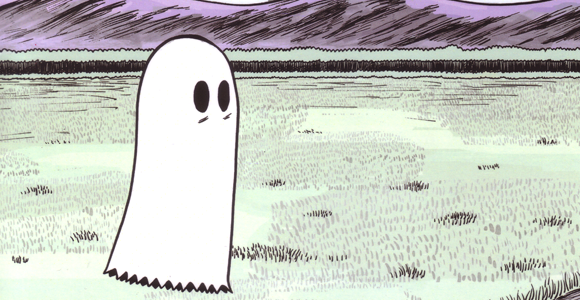
Family, loneliness, ghosts and murder in this impressive debut graphic novel.

Review: The Moon Moth by Jack Vance and Humayoun Ibrahim

A classic science-fiction tale gets a new, comics adaptation.

Feature: Taste-testing the Apocalypse, part 4

It's the end of the world as we know it, and I feel drunk.

Weekly Reviews: The Secret Service #2 and The Manhattan Projects #3

Reviews of the better offerings from the spinner racks.

05 July 2011

Interview: Tom Neely on Comics and Music


Tom Neely is a painter and cartoonist living in Los Angeles with his wife and a dog. In addition to creating several well-received comics such as The Blot and the infamous Rollins/Danzig slash fiction Henry and Glenn Forever, Tom has worked on numerous music-related projects for the likes of The Melvins, Isis, Wolves In The Throne Room and Decibel Magazine. He will destroy you.


In anticipation of his new graphic novel, The Wolf, I spoke to him about his various projects and his love of metal music.  But mostly just metal.  
-- Craig Collins
Graphic Eye: So, how did you find your way into metal?

Tom Neely: I’ve been into metal as long as I can remember listening to music.  When I was about three years old, my older brother didn’t have enough piggy bank money to afford KISS’s Love Gun.  He convinced me we should buy it together. Continuing down that path my brother and I were both way into hair metal in the ’80s, but sometime around age 12, I somehow ended up with the $5.98 EP by Metallica which got me into Thrash and Death Metal, but also introduced me to The Misfits and punk rock. I’ve been hooked ever since.

GE: You DJ at “Heavy Tuesdays” in what is purportedly “Highland Park’s hippest dive bar”. How do you like the opportunity to inflict your favourite stuff on a captive audience?

TN: I used to try and convince my friends to let me DJ their parties and everyone always hated it... But now there are people who come out to hear this stuff. It’s fun!  I love it.  And it’s always great to hear what records the other regular DJs, Scott Carlson (of Repulsion) and J. Bennett (writer for Decibel Magazine), bring every week.  Those guys know everything, so I’m always learning about new metal from them. And the bartender, Laurel, is awesome and a true metalhead and she lets us play whatever we want (except don’t play Ministry or you’ll get a lecture about why that’s not “metal”).

GE: You’ve mentioned your upcoming graphic novel The Wolf may have a soundtrack to accompany the book, created in collaboration with Aaron Turner of Isis / House of Low Culture. Without giving too much away, how do you go about creating music that appropriately interacts with art, and the story itself?

TN: Originally we planned this as a collaborative book with a soundtrack idea.  After the Mevlins book, I approached Aaron with the idea for The Wolf.  It was an interesting process for both of us, but unfortunately we felt like the collaboration wasn’t working.  I think we each decided that our parts in the project had become more personal, and it didn’t make sense to release them together. So, the book will be released without a soundtrack.  Aaron is releasing a new House of Low Culture album soon. 

GE: Metal is the subject of and an influence in a lot of your work, but you’ve also talked about being a fiend for jazz. Did either of these bear an influence on your new book The Wolf?

TN: Oh sure... I’m always listening to all kinds of music when I’m working in the studio, so it’s bound to have some influence on me.  I think my sense of timing and rhythm in comics is very influenced by the music I listen to. While working on The Wolf I listened to a lot of metal, but also a lot of experimental music and free jazz and a lot of Miles Davis’ early ’70s records. I think for my next book I’ll probably be listening to a lot more early blues and jazz.  But there’s always punk and metal in the mix. 

GE: Conversely, how did you approach Your Disease Spread Quick, creating a comic that accompanied The Melvins’ (A) Senile Animal?

TN: Hydrahead Records asked me if I’d want to do a comic book for the Melvins. Of course!  Who wouldn’t? It had some relation to the album (A) Senile Animal.  I asked for feedback from the band, but they were completely hands off and just let me do whatever I wanted.  So, I just took inspiration from the song titles like “A Talking Horse” and “Blood Witch” to come up with character ideas, and then wrote a surrealistic dreamlike story that sort of moves with the rhythm of the album. It’s cool that they let me do whatever I wanted, because I think the story, without the Melvins music, works on its own as a short surrealist comic book. 

GE: What is it that you find so fascinating about Black Metal?

TN: Well, I’ve always been into heavy music, and it’s one of the few interesting things happening in rock music these days.  And the mutations of black metal that are happening with these art rock bands who are appropriating black metal into their sound is really interesting, too. 

GE: You’ve done work that reflects the ‘mature’ side of Black Metal — the often highly developed music and artistic aesthetics involved, and its more ridiculous aspects too. What do you think of these seemingly contadictory aspects?)

TN: I like a lot of different things for different reasons. Listening to Mercyful Fate is like watching a Hammer horror movie.  It’s fun.  Listening to Wolves in the Throne Room is a completely different experience. But it’s all just a fantasy anyway... I’m just a dude makin’ comic books and listening to this stuff... some days I wanna take myself seriously, and some days I wanna listen to Dio sing about wizards and shit. 

GE: You produced Self Indulgent Werewolf to accompany a 2007 solo exhibition. How did that go down with visitors in the gallery?

TN: There was a record player with a headset in the gallery, but I think the soundtrack was largely ignored by the visitors at the show.  I only pressed 130 copies of that record and I still have most of them — ha!  But actually Aaron Turner played DJ at my opening for that show, so my music was mixed in with a lot of other weird stuff throughout the night.  The record was totally a self indulgence project for me.  I always wanted to make an album, so I did.  

GE: From the track I found online, hidden away in an Inkstuds podcast, it was pretty cacophanous stuff but with a folky thread emerging. Did you have any particular influences in its writing, or is it purely True Californian Tom Neely Black Metal?

TN: I wouldn’t call my record “black metal.”  It has a bit of that influence in a couple of the songs, and I had fun making a black metal style logo of my name, but it’s mostly experimental noisy stuff made out of my love of fucking around with instruments. I’m not really a musician, and a master of no instruments at all... But I like to make noise. 

GE: Tell us more about Grienhals.

TN: It started out as a “fake rock poster” for an art show at Floating World Comics in Portland, OR.  But then it became the name for my new one-man-band that has yet to record much.  I’ve been messing around with a few new noisy sound ideas. I hope to one day finish some more music, but music is more of my fun hobby and I need to spend most of my time making visual art. 

GE: Your love of Black Flag and The Misfits was pretty crucial in making Henry & Glenn Forever such successful comedy. Do you think you would ever approach their music again in art or comics? Seriously or comedically?

TN: We are planning a second Henry & Glenn book.  It’s going to be very different from the first one. We have some good ideas going. I would also love to do more animation with the characters (I made a short Henry & Glenn Forever X-mas special cartoon and released it on YouTube back in December). So, there’s still life in the idea for now.  I don’t wanna beat it to death, but as long as it’s fun, and we can find new ideas, we’ll do some more Henry & Glenn stuff. 


GE: Regarding the Henry & Glenn animation — how long did it take, and was it a fun undertaking?

TN: From storyboards to YouTube, it took me about four months to complete. I wrote it last August, got some friends together to do the voices, then spent the next three months animating it all by night and whenever I had some spare time. Then my brother, who does music for film and TV, helped me with all the sound and everything. We finished it about 2 days before I put it up on YouTube.  It was a lot of work, but it was also a lot of fun and reminded me how much I enjoy doing animation. 

GE: How did you pick up the animation skills? Do you plan any other animations based on your other work?

TN: I’ve always been interested in animation.  When I was a kid I used to make stop-motion movies with my Star Wars figures and Transformers. I was always messing around with it for fun, but when I was about halfway through my MFA in painting, I started to realize there wasn’t much I could do with a painting degree other than work in an art supply store. I had some friends who were working for the Disney websites, so I started teaching myself to animate while finishing art school. After graduating, with the help of those friends, I got a job as a Flash animator at Disney online back in 2000.  I left there after a couple of years and have since been freelancing in animation to pay the bills and bankroll my comics ambitions. I’ve made several other little short animations over the years, including an anti-Bush short film I made with a friend back in 2004 and a music video for The Muffs song “Don’t Pick On Me.” I’d love to do more animation of my own, but it’s very time consuming. Plus, since that’s what I’m doing all day to pay the bills, when I’m feeling creative I’d rather go draw comics than animate.  But I do hope to do more.  And I’ve got a really good idea for another Henry & Glenn cartoon that I’d love to do in the near future.  Argh... always more ideas than time.  


GE: You mentioned that producing a Morbid Angel album cover would be a dream job. What else would you love to do?

TN: Yeah that was 14 year old tom that wants to do the Morbid Angel cover.  I’d imagine they’re so big at this point, that doing a cover for them would be a nightmare of approvals and sketches and too many chefs in the kitchen... I think I prefer working with smaller bands where it can be more of a collaborative process. I might be doing another book project with my friends’ band in the near future. 

What else would I love to do?  Live in Hawaii and make art all day long.

GE: While we’re on the topic of Morbid Angel, have you heard the new album? Was it “Too Extreme!” or do you say “I Am Morbid”?

TN: Oh, I’ve been too scared to listen to it yet.  They’re probably my all-time favorite death metal band and I was anticipating the release, but I’ve heard so many conflicting reviews that I think I have to give it some time before I listen, so I can have my own opinion. Ask me again next year maybe.*

GE: And finally, let’s play Desert Island Discs. You’ve run aground on an island of the blackest stone covered in inverted palm trees. What metal albums do you need to survive?
TN: Oh the desert island question always causes some anxiety in me... I like way too much music...  and the idea of being limited to a few records on a desert island fills me with the dread of getting tired of one of these favorite albums.  Can I cheat and bring a solar powered iPod with me?


*Tom later emailed to say: Oh fuck... I just got curious and started listening to it.  

Feature: Shapes Shifting - pt. 2

Part II: The Ghost of Merlock Jones

Compared to those in comics, animated shape-shifters are deficiently mysterious: not concerning their roles in the narrative, but the way in which they change and the effect of the change upon the reading experience. Rather than changing with the help of fluid motion, comics shape-shifters have to pass through gutter. If they were to undergo a change within one panel, they run the risk of muddling the action with what could be interpreted as two separate characters, or the sense of time may simply disappear. The comics gutter actually gives shape-shifters more space, specifically, blank space, negative space, in which they do nebulous, invisible tricks.

Again, as with “Duck Amuck,” we’re reading the following example by transplanting ourselves into the world/medium of the character rather than wrenching him into our own. The laws of cartoon physics (if there are any at all) are frighteningly different from our own, and if we insist on placing a cartoon character in 4-D, conforming to the law of gravity, or the conservation of mass, their abilities and personalities become negligible and boring, respectively.
            
Merlock Jones first appeared in E.C. Segar’s Thimble Theatre in June 1932, preceding the start of a new Popeye adventure called “The Eighth Sea.” Castor Oyl, Popeye’s frequent cohort and partner with whom he founded a detective agency in a previous story, fears Popeye will be hurt or killed while visiting the dangerous hide out of Woo Fong, keeper of the precious black parrot that holds the secret to a great treasure. Castor tasks Merlock Jones, a master of disguise, with tailing Popeye and later, once Popeye and his crew are set to sail, with stowing away and guarding the worthless King Blozo. “Merlock Jones,” Castor says giving the sleuth his orders. Merlock, it should be known, has already taken several guises in three daily strips’ time. “...Won’t you let me see your real face?” Merlock replies: “No living man hath seen my pan—not even myself.”
            
Previously, when he trails Popeye on the way to Woo Fong’s dockside hideout, Merlock’s shape-shifting is drawn as a flurry of hands and motion lines and takes up one panel of space per change. The base form is in the panel preceding the change, the new one following. But when he aims to stow away, the change is quite spectral. We never see Merlock stowing away. It happens in the gutters, so to speak, and in fact the reader, because an entire month passes between Merlock receiving his orders and reappearing aboard Popeye’s ship, could wonder whether Segar redacted Merlock from the adventure entirely. If we re-read the “The Eighth Sea,” returning to this point of absence it’s clear here is where Merlock initially shape-shifts, and that it is indeed absence the non-shape he assumes. Merlock, if our attention is on his whereabouts at the beginning of “The Eighth Sea,” haunts the strip until he reappears a month later.* One week after Merlock receives his orders from Castor, a stow-away appears aboard Popeye’s ship: an old granny named Missus Snoodenbocker who claims to have mistook Popeye’s boat for a ferry. Now, for all the reader knows, and in fact what makes the most sense to believe, is that Missus Snoodenbocker is none other than Merlock Jones. Even though we don’t see it, we know Merlock stowed away, and based on past experience we know he can take whatever shape he chooses. That Missus Snoodenbocker turns out not to be Merlock is less important than that for an entire month her character is possessed by Merlock Jones, and it isn’t until he reappears that she regains her identity: her “self,” effectively. Any other member of the cast would be ill equipped for a haunting such as this. It is the privilege of the shape-shifter.
            
Besides his ghastly non-presence, his idea-shape that possesses Missus Snoodenbocker, Merlock’s absence does have a concrete representation: the strip-shaped (or page-shaped depending on the format) latticework of the comics gutter. This is the shape that symbolizes the ghostly nature of the shape-shifter that Merlock taps into for an entire month of story. It is a symbol, like the capricious, frenetic illustrator in “Duck Amuck,” of the possibility inherent in the white page. And a shape-shifter, again, because of its kinship with the basic creative process in comics and cartoons, is an accessible tool to help recognize the ethereal properties of cartoons and comics.
-- Ian Burns

*The Fantagraphics collection, Popeye Vol.3, “Let’s You and Him Fight!” provided the structure for Merlock’s absence and return. Specifically: They have created a chapter heading titled “Presenting: Merlock Jones.”

Comics: Plague Johnny #4


Feature: Jim Wooding's Congress of the Animals

It's frustrating when Jim Woodring is referred to as a cartoonist, given that much of his output is in the form of fine art — even bordering on performance art with his Nibbus Maximus project.  So it's comforting that Woodring himself uses that same epithet, seeing all his art as cartooning in its own way.  To hear him talk about his craft is like being warped into the Unifactor of the Frank stories, such is the unsettling and often consciousness-altering effect of Woodring revelations and explications.

Much like with Weathercraft, his previous graphic novel, Woodring is launching his most recent work, Congress of the Animals with a series of exploratory talks. These lectures are essential for the reader who wishes to pin some form of "definitive" meaning on the story, but even for those who like their authors dead, there are some insightful comments on art, life and spirituality from the artist.

The following footage was shot at Elliot Bay Bookstore in Seattle, WA on the 30th June 2011 by Ian Burns.

18 June 2011

Feature: Shapes Shifting - pt. 1

Part I – “Ain’t I a stinkah?”

The first and most symbolic barrier between imagination and a complete story in comics and cartooning is a blank page.  The blank page represents possibility, and there, at that simple, stripped down level of creation, imagination collides with possibility and the resulting shock, when ideas turn into shapes, into characters, scenes and stories, wildly displaces possibility in favor of concrete, two-dimensional illusions. It’s their kinship with this basic element that makes the shape-shifting character a representation of creation, in cartoons or comics, within the space that gives that character a reason for existing. In their space on the page, with each change, they reenact the collision of imagination and possibility. Just as a model of the Solar System that simulates the revolution of the planets around the Sun, the representation has no meaning without that which it represents.

Shape-shifters aren’t necessarily superior to any other type of character just because they shape-shift: they don’t possess any inherent sympathies with readers that other types of characters don’t have. However, shape-shifters do broaden our knowledge of cartoon and comics territory that they inhabit.

The page is a space, and lines, shapes, colors are tools which, a shape-shifter can use to direct a narrative to the brink of cartoon possibility. Or perhaps, more accurately, he is directed. Such is the case in Chuck Jones’ and Michael Maltese’s phenomenal Looney Tunes sketch entitled “Duck Amuck.” Aired in 1953 and voiced by the incomparable Mel Blanc (a shape-shifter in his own right), “Duck Amuck,” in which Daffy Duck falls prey to a malevolent illustrator and is forced to improvise a number of costumes, styles, dances, gestures and anatomic disfigurements under an increasingly capricious brush, is basically a treatise on the lack of space between one form and another in cartoons. If the illusion of the cartoon is stripped away, the illusion of three-dimensional space, it becomes apparent the only thing stopping cartoons from losing consistent form is the force of their creator*—that is, consistent form within a relatively small amount of time rather than over a large span in which several illustrators draw different interpretations of the same character. It’s true a cartoon gets its vitality from human interaction, but the quality of life is determined by which quality of mind an illustrator harnesses when drawing. In other words, the rate and manner in which shapes change is dependent upon temper.

In “Duck Amuck” the creative process is artificially accelerated to show just how volatile the mixture of temper and cartooning can actually be. For most of the cartoon Daffy moves from right to left along a conveyor-belt style canvass. Each new section of the canvass (roughly two to five seconds in duration) is a new set, new scenery, but Daffy takes it all in stride. He’s a professional, after all. When the illustrator draws a scene with no color, Daffy exclaims, “It may come as a complete surprise to you to find that this is an animated cartoon, and that in animated cartoons they have scenery.” When French hills give way to alpine snow, Daffy becomes a skier; when a Hawaiian island appears, Daffy wields a ukulele and lei. The illustrator within “Duck Amuck,” Daffy’s antagonist**, at one point erases Daffy completely, to which he cries, “Alright, Wise Guy … Where am I?” Daffy undergoes auditory changes as well: trying to throw a tantrum, he’s thwarted by a starling chicken cry coming from within his bill, and at one point he’s stricken mute altogether.

What’s special about Daffy’s role in “Duck Amuck” is that he isn’t a shape-shifter normally: it isn’t a recognizable part of his character. So rather than touting an “anything is possible in cartoons” message, even though that’s entirely true, he shows us that any comics or cartoon character can become a shape-shifter depending on the temper of their illustrator at the time of creation. Anything may be possible, but more importantly it must be acknowledged that a creator is capable of anything. “Duck Amuck,” in seven odd minutes, brings to the forefront everything we already know about cartoons, but that which we gloss over for entertainment’s sake forces us to consider how much can happen on the page when possessed by imagination.

-- Ian Burns

NEXT: Merlock Jones and the masters of disguise!

* This is, I admit, an idealistic view in which creators exist in a vacuum wherein the trials of the industry don’t affect the creative process. The reader can assume, then, that I’m speaking about creation at its most primal, pure level.

**SPOILERS!!! It’s Bugs.

Twitter Delicious Facebook Digg Stumbleupon Favorites More